

TL;DR:
- Car leasing is a fixed-term agreement where users pay for vehicle depreciation, not the full purchase price. It offers lower monthly costs and access to new models but lacks ownership equity and can incur excess charges if mileage limits are exceeded. Leasing is ideal for drivers prioritizing affordability, short-term commitments, and regular vehicle upgrades, while buying benefits long-term cost efficiency and asset building.
Car leasing is a fixed-term arrangement where you pay to use a new vehicle for an agreed period, covering the vehicle's depreciation rather than its full purchase price. Known formally in the UK as Personal Contract Hire (PCH), this approach typically delivers lower monthly payments than a standard finance loan. You return the car at the end of the term, with no ownership and no resale headache. If you are weighing up why lease a car versus buying outright, the answer usually comes down to three things: monthly affordability, access to newer vehicles, and the convenience of a clean handback.
What are the financial benefits and costs of leasing a car?
Lease payments cover depreciation plus finance charges, not the full vehicle price. This is why monthly costs are consistently lower than a purchase loan on the same car. If a new car is worth £30,000 and its residual value after three years is £18,000, you are financing £12,000 of depreciation, not £30,000. That difference is significant for monthly cash flow.
The upfront costs are worth understanding clearly. Leasing typically requires upfront fees such as an initial rental, which is usually equivalent to three to nine monthly payments, alongside any acquisition fees. Providers like Lease World offer no-deposit options on eligible vehicles, which removes this barrier entirely for some drivers. Strong credit is generally required, so checking your credit file before applying saves time.
The financial drawbacks are real and should not be ignored. You build no ownership equity despite making payments every month. At the end of the contract, you hand the car back and start again. Leasing offers financial flexibility and access to newer vehicles, but no equity is built unlike buying. For drivers who view a car as an asset, this is a fundamental limitation.
Additional costs can appear at the end of the contract if you exceed your agreed mileage or return the vehicle with damage beyond fair wear and tear. These charges can be substantial, so they deserve careful attention before you sign.
Leasing vs buying: a cost comparison
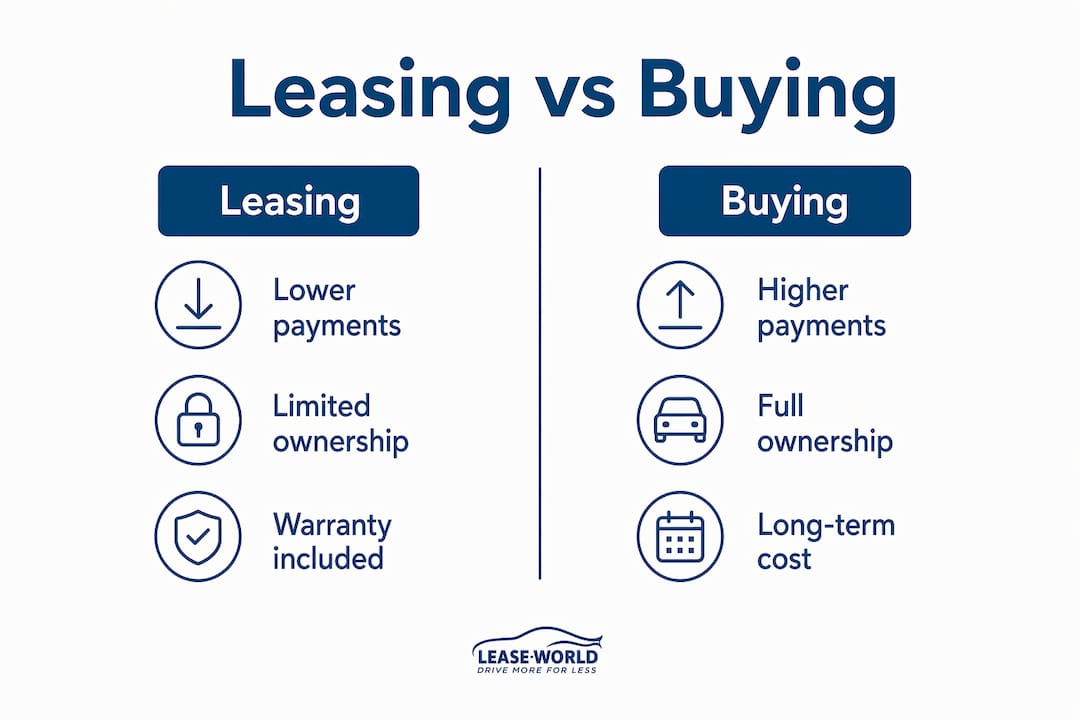
| Factor | Leasing | Buying outright |
|---|---|---|
| Monthly payment | Lower (covers depreciation only) | Higher (covers full vehicle value) |
| Upfront cost | Initial rental or deposit | Full price or large deposit |
| Ownership equity | None | Full ownership after final payment |
| End-of-term process | Return vehicle | Sell or keep |
| Long-term cost | Higher over multiple cycles | Lower if vehicle kept long term |
| Repair liability | Covered by warranty in most terms | Owner's responsibility after warranty |
Pro Tip: Before comparing monthly figures, calculate the total cost over three years including the initial rental, all monthly payments, and any expected end-of-term fees. This gives you a true like-for-like figure against a purchase loan.
How does car leasing work in practice?
UK PCH agreements run for 24 to 48 months with an initial rental followed by fixed monthly payments. The contract specifies an annual mileage allowance, typically between 8,000 and 15,000 miles per year, and the car must be returned in a condition consistent with fair wear and tear guidelines. Understanding how car leasing works from the outset prevents surprises at handback.

Most leases align with the manufacturer's warranty period, which means mechanical repairs are generally covered throughout the contract. This is one of the genuine car leasing advantages that buyers on older vehicles do not enjoy. Routine maintenance such as servicing, tyres, and MOTs remains the lessee's responsibility unless a maintenance package is added to the agreement.
The end-of-lease process is straightforward when contract conditions are met. Lease-end returns avoid sales negotiations. You book an inspection, the vehicle is assessed against the BVRLA fair wear and tear guide, and you hand back the keys. What happens at lease end is far simpler than selling a used car privately or part-exchanging at a dealership.
Key contract conditions to check before signing:
- Annual mileage allowance and the pence-per-mile charge for exceeding it
- Fair wear and tear standards referenced in the agreement, usually the BVRLA guide
- Maintenance responsibilities and whether a maintenance package is included
- Early termination clauses and the financial penalties involved
- Modification restrictions, as most leases prohibit any changes to the vehicle
- Insurance requirements, as fully comprehensive cover is mandatory throughout the term
Pro Tip: If your annual mileage is variable, overestimate slightly when setting your allowance. The cost of buying additional miles upfront is almost always lower than paying excess mileage charges at the end of the contract.
Who benefits most from leasing a car?
Leasing suits those prioritising lower monthly payments and shorter vehicle commitments, whereas buying suits higher mileage and long-term ownership. This distinction is the most practical starting point for deciding which route fits your situation.
Leasing works best for drivers who:
- Want to drive a new car every two to four years without the hassle of resale
- Have predictable annual mileage, typically under 12,000 to 15,000 miles per year
- Prefer fixed, budgetable monthly costs with no unexpected repair bills during the warranty period
- Value the convenience of returning a vehicle rather than managing a private sale
- Want access to the latest safety technology, fuel efficiency improvements, or electric vehicle models without a large capital outlay
Leasing is less suitable for drivers who cover high annual mileage, plan to keep a vehicle for more than five years, or want to build equity in an asset over time. If you regularly exceed 20,000 miles per year, the excess mileage charges at contract end can erode the monthly payment savings entirely. Drivers with irregular income may also find the fixed payment commitment less comfortable than owning a vehicle outright.
The reasons people lease cars often come down to cash flow management as much as preference. Keeping capital free for other uses, whether a business investment or a home improvement, is a legitimate financial reason to lease rather than buy.
What are the risks and limitations of leasing?
The most common risk in leasing is underestimating your mileage. Exceeding mileage limits leads to additional charges after inspection at lease end, and these can run to hundreds or thousands of pounds depending on the contract rate and the overage. A driver who agrees to 10,000 miles per year but consistently covers 14,000 will face a significant bill at handback.
"End-of-term fees may erode leasing benefits if mileage or wear limits are exceeded, so reading the contract is critical." This is not a theoretical risk. Scuffs on alloy wheels, chips in the windscreen beyond a certain size, and interior staining are all examples of damage that falls outside fair wear and tear and attracts charges.
The absence of ownership equity is a structural limitation, not just a financial one. After three years of payments, you have no asset. Two consecutive three-year leases will almost always cost more in total than buying one car and keeping it for six years, as KBB confirms. This is the core trade-off at the heart of leasing versus buying.
Early termination is another area where drivers can be caught out. Ending a lease contract before the agreed term typically triggers a penalty calculated as a percentage of the remaining payments. Life circumstances change, but lease contracts are not designed to accommodate that flexibility cheaply. Understanding the mileage limit implications and termination terms before signing is not optional. It is the difference between a good leasing experience and a costly one.
How does leasing compare with buying for different needs?
The leasing vs buying decision is not simply about monthly cost. It involves ownership, flexibility, lifestyle, and long-term financial goals. Both options have genuine merit depending on your circumstances.
Short-term, leasing wins on affordability. Monthly payments are lower, upfront costs can be minimal with no-deposit options, and the car is always under warranty. For someone who changes cars every three years regardless, leasing removes the resale risk and the depreciation hit that comes with owning a new car in its first years.
Long-term, buying wins on total cost. A car purchased outright and kept for eight to ten years costs far less per year than a succession of lease agreements. Ownership also gives complete freedom: unlimited mileage, the ability to modify the vehicle, and no penalties for wear. Buying suits drivers who treat a car as a long-term tool rather than a regularly refreshed convenience.
| Need | Leasing | Buying |
|---|---|---|
| Lower monthly outgoings | Strong advantage | Higher payments |
| Long-term cost efficiency | Less efficient over time | More efficient if kept long term |
| Access to new models regularly | Built into the model | Requires selling and buying again |
| High annual mileage | Costly due to excess charges | No restriction |
| Vehicle modifications | Not permitted | Full freedom |
| Resale responsibility | None | Owner manages sale |
The honest answer to whether leasing a car is worth it depends entirely on your driving habits and financial priorities. For the right driver, the car leasing advantages are genuine and meaningful. For the wrong driver, the restrictions and end-of-term costs can make it an expensive lesson.
Key takeaways
Leasing a car delivers lower monthly payments and warranty-backed convenience, but costs more than buying long term and builds no ownership equity.
| Point | Details |
|---|---|
| Lower monthly payments | Lease payments cover depreciation only, not the full vehicle price. |
| No ownership equity | Monthly payments build no asset value; the car is returned at term end. |
| Mileage limits matter | Exceeding agreed mileage triggers per-mile charges that can be costly. |
| Warranty coverage included | Most leases align with manufacturer warranty, reducing repair exposure. |
| Long-term cost trade-off | Two leases typically cost more than buying one car and keeping it long term. |
Leasing in practice: what I have actually seen work
The question I hear most often is whether leasing is genuinely worth it or just a clever way to make an expensive car feel affordable. My honest view, after years of working with drivers across a wide range of circumstances, is that leasing is an excellent tool when used deliberately and a poor one when used by default.
The drivers who get the most from leasing are those who have genuinely assessed their mileage, understand the contract terms before signing, and treat the monthly payment as the full cost of motoring for that period, not a stepping stone to ownership. They are not surprised at handback because they have managed the car accordingly throughout the term.
The drivers who struggle are those who underestimate their mileage, ignore the fair wear and tear guide, or sign a three-year contract without considering what happens if their circumstances change. If your job involves unpredictable travel or your family situation is likely to shift, a shorter term or a higher mileage allowance is worth the extra monthly cost.
One thing I would add that most articles skip: if your circumstances do change mid-contract, contact the leasing company early. Communicating early with the leasing company can allow adjusting mileage or terms to avoid penalties. Most providers would rather adjust an agreement than deal with a default or a damaged return. Lease World, in particular, is built around that kind of direct conversation rather than leaving customers to navigate problems alone.
Leasing is not better or worse than buying. It is a different financial tool, and the right one depends entirely on how you use it.
— Jason
Find your ideal lease with Lease World
Lease World makes it straightforward to find a personal or business lease that fits your budget and driving habits, with no hidden fees and complimentary UK delivery on eligible vehicles.
Whether you are new to leasing or switching from a previous agreement, the personal car leasing options at Lease World cover a wide selection of makes and models with fixed monthly payments and no-deposit deals available. If you want to go deeper before committing, the leasing guides cover everything from contract terminology to cost comparisons in plain language. Ready to see what is available? Request a quote and a member of the team will help you find the right deal.
FAQ
Why lease a car instead of buying it?
Leasing delivers lower monthly payments because you pay for depreciation only, not the full vehicle price. It also keeps you in a newer car under warranty without the hassle of resale.
What does PCH mean in car leasing?
PCH stands for Personal Contract Hire, the standard UK term for personal car leasing. It is a fixed-term agreement where you pay monthly to use the vehicle and return it at the end of the contract.
What happens if I go over my mileage on a lease?
Exceeding your agreed annual mileage triggers a per-mile excess charge calculated at the end of the contract. Setting your mileage allowance slightly above your expected use is the most cost-effective way to avoid this.
Can I end a car lease early?
Early termination is possible but typically incurs a penalty based on the remaining payments. Contacting your leasing provider as early as possible gives the best chance of adjusting terms rather than paying a fixed exit fee.
Is leasing a car worth it for low-mileage drivers?
Leasing is well-suited to drivers covering under 12,000 to 15,000 miles per year who want predictable costs and regular access to new vehicles. For higher-mileage drivers, the excess charges at contract end can outweigh the monthly payment savings.