

TL;DR:
- Fleet leasing allows UK businesses to rent multiple vehicles under fixed-term contracts without ownership, reducing depreciation risk and preserving capital. It offers predictable monthly costs, tax advantages, and flexible fleet upgrades, making it preferable for stable, predictable operations. However, businesses must carefully manage mileage, vehicle condition, and tax rules to avoid costly penalties and maximize benefits.
Fleet leasing is defined as a fixed-term arrangement where a business rents multiple vehicles from a leasing provider, paying a set monthly fee without ever owning the vehicles outright. It is the standard vehicle acquisition method for UK companies that need predictable transport costs and want to avoid the financial exposure of ownership. Approximately 75% of UK businesses choose to lease fleet vehicles rather than buy them. That figure reflects a clear preference for capital flexibility over asset accumulation. Lease World works with businesses across the UK to structure fleet agreements that match operational needs and budget requirements.
What is fleet leasing and how does it differ from standard leasing?
Fleet leasing, also known as fleet contract hire, is the process of sourcing multiple vehicles under a single or coordinated set of lease agreements. Standard personal or single-vehicle leasing follows the same principle, but fleet leasing applies it at scale, typically covering five or more vehicles for a business. The lessee pays fixed monthly rentals, uses the vehicles for the agreed term, and returns them at the end. No ownership transfers, and no residual value risk sits with the business.

The fleet leasing definition separates it from outright purchase in one critical way: depreciation stays with the leasing provider, not the company. New commercial vehicles lose 20–40% of their value in the first year alone. That is a significant financial exposure that leasing removes entirely from a company's balance sheet.
How does fleet leasing work for UK companies?
Fleet leasing contracts follow a clear structure. Understanding each stage helps businesses avoid surprises and negotiate better terms.
-
Choose your vehicles and term. Contracts typically span 1–5 years with fixed monthly payments that include depreciation and, in many packages, scheduled maintenance. The business selects the makes, models, and specifications it needs.
-
Agree on annual mileage. The leasing provider prices the contract partly on expected mileage. Underestimating this figure leads to excess mileage charges at the end of the term, so accuracy matters from the outset.
-
Choose your lease type. The two main structures are contract hire and finance lease. Contract hire is the most common: the business pays to use the vehicle and returns it at term end with no option to purchase. A finance lease gives the lessee more flexibility, including the possibility of a secondary rental period or a share of the vehicle's sale proceeds.
-
Manage the vehicle during the term. The business is responsible for keeping vehicles in good condition and within the agreed mileage. Maintenance packages can be bundled into the monthly payment to simplify this.
-
Return the vehicle. At the end of the contract, vehicles are inspected against the British Vehicle Rental and Leasing Association (BVRLA) fair wear and tear guidelines. Damage beyond those standards incurs charges.
Pro Tip: Request a maintenance-inclusive package when setting up a fleet lease. It converts unpredictable servicing costs into a fixed monthly line item, which makes budgeting far more reliable.
What are the main benefits of fleet leasing compared to buying?
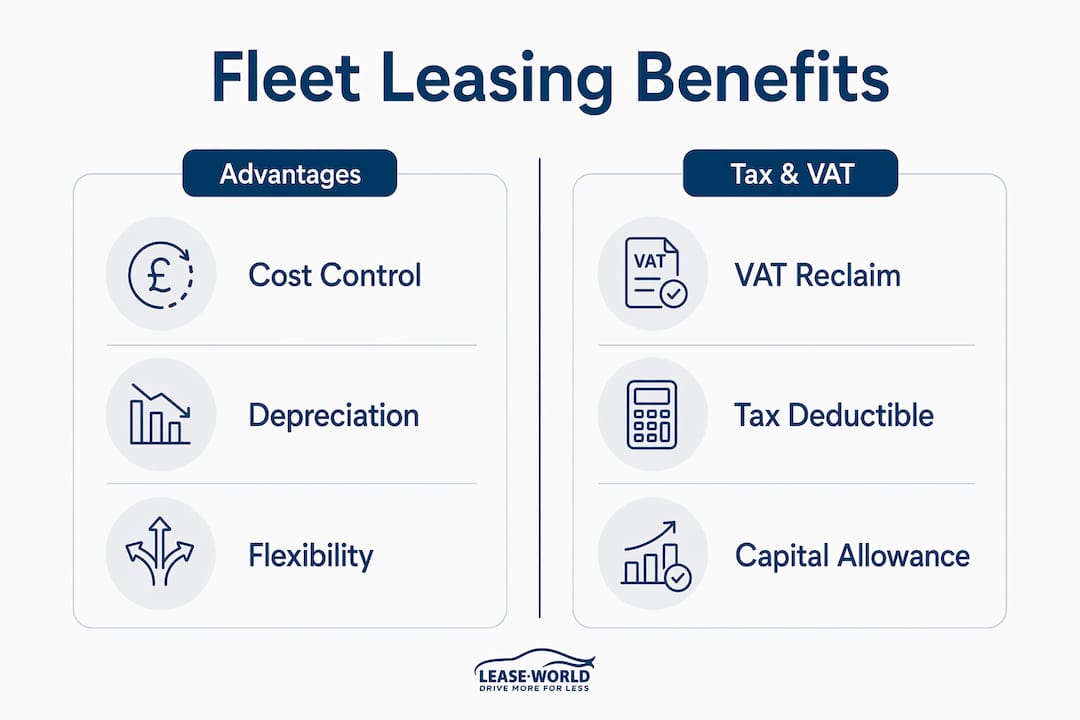
Fleet leasing delivers advantages that outright purchase cannot match for most UK businesses. The benefits are financial, operational, and administrative.
- Capital preservation. Buying a fleet ties up significant cash or credit in depreciating assets. Leasing keeps that capital free for core business investment.
- Depreciation protection. Depreciation is the largest hidden cost in vehicle ownership. Leasing transfers that volatility entirely to the leasing provider.
- Predictable monthly costs. Fixed payments make cash flow forecasting straightforward. There are no surprise repair bills when maintenance is included in the package.
- Access to newer vehicles. Leasing gives businesses the agility to upgrade fleets regularly, which is particularly relevant as the UK market shifts toward lower-emission vehicles.
- VAT efficiency. VAT-registered businesses can reclaim 50% VAT on cars used for mixed business and private purposes, or 100% on vehicles used exclusively for business or on commercial vehicles such as vans.
The pros and cons of car leasing always depend on a company's specific financial position, but for businesses prioritising cash flow and operational flexibility, leasing consistently outperforms buying. The combination of fixed costs, depreciation protection, and regular vehicle upgrades makes it the preferred model for the majority of UK fleet operators.
What are the crucial tax and VAT considerations in UK fleet leasing?
Tax treatment is one of the most important factors when evaluating fleet leasing for a UK business. The rules reward lower-emission choices and penalise higher-emitting vehicles.
VAT reclaim rules
VAT-registered businesses reclaim 50% of the VAT on leased cars used for both business and private purposes. The full 100% is available only when the vehicle is used exclusively for business, with no private use whatsoever, or when the vehicle is a commercial van. This distinction matters significantly for fleet managers structuring agreements.
Corporation tax deductibility
Lease rental payments are generally deductible against corporation tax as a business expense. However, leasing costs for cars emitting over 50g/km CO2 are restricted to 85% deductibility. The remaining 15% cannot be claimed. That restriction creates a direct financial incentive to choose electric or low-emission vehicles for a company fleet.
Tax deductibility in leasing fluctuates with CO2 emissions, adding a financial incentive for businesses to choose low or zero-emission fleets. A business running 20 diesel cars above the 50g/km threshold pays more in effective tax than one running the equivalent electric fleet. The road tax implications for leased vehicles also vary by emission band and are worth reviewing before finalising any fleet agreement.
Capital allowances for vans from 2026
From 2026, businesses can claim a 40% first-year capital allowance on leased vans that qualify as main-rate plant and machinery. This change makes van leasing considerably more attractive from a tax perspective. It is a meaningful shift that fleet managers running commercial vehicle operations should factor into their acquisition decisions.
Pro Tip: If your fleet includes cars above 50g/km CO2, model the 85% deductibility restriction into your total cost of ownership calculation before signing. The difference over a three-year term can be substantial.
| Tax consideration | Rule |
|---|---|
| VAT on leased cars (mixed use) | 50% reclaimable for VAT-registered businesses |
| VAT on commercial vehicles | 100% reclaimable when used exclusively for business |
| Corporation tax: low-emission cars | Full lease rental deductible |
| Corporation tax: cars over 50g/km CO2 | Only 85% of lease rental deductible |
| First-year allowance on leased vans (from 2026) | 40% first-year capital allowance available |
What are the limitations and risks of fleet leasing?
Fleet leasing is not without constraints. Businesses that enter agreements without understanding the restrictions often face costs that erode the financial benefits.
- Mileage limits. Every contract sets an annual mileage cap. Exceeding that limit results in additional charges that can offset the cost savings leasing provides. Charges are typically calculated per mile over the agreed limit.
- Damage penalties. Vehicles must be returned in a condition consistent with BVRLA fair wear and tear standards. Damage beyond that standard, including kerbed alloys, dents, or interior staining, attracts end-of-contract charges.
- No vehicle modifications. Leased vehicles cannot be permanently modified. Businesses that need specialist equipment fitted, such as refrigeration units or custom racking, face restrictions that ownership does not impose.
- Early termination costs. Ending a lease contract before the agreed term typically incurs significant financial penalties. Fleet requirements need to be forecast accurately before signing.
- No asset accumulation. Unlike ownership, leasing builds no equity. At the end of the term, the business has no vehicle asset to sell or retain.
Accurately forecasting mileage and vehicle condition is the single most effective way to prevent costly penalties under a UK fleet leasing contract. Businesses that review their actual mileage data before renewing or entering new agreements consistently avoid the most common end-of-term charges.
How should businesses decide between leasing and buying their fleet vehicles?
The choice between leasing and buying depends on three factors: cash flow preference, operational requirements, and how much the business values asset control.
Leasing suits businesses that prioritise predictable monthly costs, want access to newer vehicles, and have no need to modify their fleet. It works particularly well for companies with stable, predictable mileage patterns and a preference for keeping capital free. The decision between buying and leasing ultimately comes down to whether the business values flexibility or long-term asset ownership more.
Businesses with specialist vehicle modification needs or unpredictable mileage are better suited to outright ownership. A construction company that needs custom-fitted vehicles, or a courier business with highly variable annual mileage, will find ownership more cost-effective and operationally practical.
Hire Purchase offers a middle ground between leasing and buying. It spreads the purchase cost over time, includes the asset on the balance sheet, and transfers ownership at the end of the term. It suits businesses that want eventual ownership but need to preserve cash flow during the acquisition period.
Pro Tip: Align your lease term with the vehicle's expected useful life in your operation. A three-year lease on a vehicle you would typically replace after four years creates an unnecessary gap. Match the contract to your actual replacement cycle.
Key takeaways
Fleet leasing transfers depreciation risk to the provider, delivers fixed monthly costs, and offers UK businesses significant tax advantages when vehicles are low-emission.
| Point | Details |
|---|---|
| Fleet leasing definition | Businesses rent multiple vehicles under fixed-term agreements without taking ownership. |
| Depreciation protection | Leasing providers absorb first-year value loss of 20–40%, not the lessee. |
| VAT reclaim | VAT-registered businesses reclaim 50% on mixed-use cars or 100% on exclusively business-use vehicles. |
| Emission-based tax rules | Cars emitting over 50g/km CO2 attract only 85% corporation tax deductibility on lease costs. |
| Leasing vs buying | Ownership suits high-mileage or heavily modified fleets; leasing suits stable, predictable operations. |
Why I think most businesses underestimate the tax angle in fleet leasing
Most fleet managers focus on the monthly payment when evaluating a lease. That is the wrong starting point. The real financial story sits in the tax treatment, and it is one that rewards businesses willing to think ahead.
The 85% deductibility rule for cars above 50g/km CO2 is not a minor technicality. Across a fleet of 15 or 20 vehicles, the non-deductible 15% compounds into a meaningful tax cost over a three-year term. Businesses that switch to electric or sub-50g/km vehicles do not just benefit from lower fuel costs. They access full deductibility, which changes the total cost calculation entirely.
The 2026 capital allowance change for leased vans is equally significant and still underappreciated. A 40% first-year allowance on qualifying vans is a genuine incentive that makes leasing commercially attractive for businesses that previously favoured purchase.
My honest observation after years working in this sector is that the businesses that get the most from fleet leasing are the ones that treat it as a financial planning decision, not just a procurement one. Accurate mileage forecasting, emission-aware vehicle selection, and a clear understanding of end-of-contract conditions are what separate businesses that save money from those that merely defer costs.
Consult a leasing adviser before committing to any fleet agreement. The contract terms are negotiable, the tax position is nuanced, and the right structure for one business is rarely the right structure for another.
— Jason
How Lease World helps UK businesses find the right fleet lease
Lease World works with businesses across the UK to find fleet leasing agreements that fit their size, budget, and vehicle requirements. Whether you need a single commercial van or a coordinated fleet of cars, Lease World provides transparent pricing, fixed monthly payments, and no-deposit options on eligible vehicles.
The team at Lease World compares contracts across the market so you do not have to. From business car leasing to commercial van fleets, every agreement comes with dedicated support and clear terms. Businesses looking for commercial vehicle options can browse window van lease deals or explore the full range of leasing guides to understand which structure suits their operation. UK delivery is included on eligible vehicles, and the process from enquiry to handover is straightforward.
FAQ
What is the fleet leasing definition in simple terms?
Fleet leasing is a fixed-term rental arrangement where a business pays monthly to use multiple vehicles without owning them. The leasing provider retains ownership and absorbs depreciation risk throughout the contract.
How long do fleet leasing contracts typically last?
Fleet leasing contracts in the UK typically run for 1–5 years, with two to four years being the most common term for business fleets.
Is fleet leasing a good option for small businesses?
Fleet leasing suits small businesses that need predictable monthly costs and want to avoid large capital outlay. It works best when mileage is stable and vehicles do not require permanent modification.
What happens at the end of a fleet lease?
Vehicles are returned to the leasing provider and inspected against BVRLA fair wear and tear standards. Damage beyond those standards, or excess mileage, results in additional charges.
Can a VAT-registered business reclaim VAT on fleet leasing costs?
Yes. VAT-registered businesses reclaim 50% of the VAT on leased cars used for mixed business and private purposes, or 100% on vehicles used exclusively for business or on commercial vans.