

TL;DR:
- Car leasing is a long-term rental where you pay monthly to use a vehicle you never own, with no option to buy at the end. It involves fixed payments based on depreciation, mileage limits, and adherence to wear and tear guidelines, with the finance company being your contractual party. Leasing suits those seeking predictable costs and new cars frequently, but careful consideration of mileage and damage rules is essential to avoid costly charges.
Car leasing confuses a surprising number of people in the UK, and that confusion can be costly. Many drivers assume it works like a hire purchase agreement, or muddle it with PCP finance, only to discover the differences matter enormously when the contract ends. What is car leasing, exactly? In simple terms, it is a long-term rental arrangement where you pay a fixed monthly amount to use a vehicle you never own. This guide explains how leasing works, what it costs, how it compares with buying and PCP, and what the small print about mileage and wear actually means for your wallet.
Table of Contents
- Key takeaways
- What is car leasing and how does it work?
- Leasing vs buying vs PCP: what actually differs
- Mileage limits, wear and tear, and end-of-lease charges
- The leasing process from start to finish
- My honest take on whether leasing is right for you
- Find your next lease deal with Lease World
- Common questions
Key takeaways
| Point | Details |
|---|---|
| Leasing is long-term rental | You pay monthly to use a vehicle but never own it at the end of the agreement. |
| Payments reflect depreciation | Monthly costs are calculated on the car's predicted value loss, so newer models with strong residuals cost less to lease. |
| Mileage limits matter | Exceeding your agreed annual mileage triggers excess charges that can reach up to 30p per mile on premium vehicles. |
| Fair wear and tear has rules | End-of-lease inspections use formal BVRLA guidelines, not common sense, so even minor damage can generate a charge. |
| Finance company is your contract party | All queries and issues during the lease go to the finance company, not the dealer who arranged it. |
What is car leasing and how does it work?
Car leasing, formally known as Personal Contract Hire (PCH) for private individuals, is an agreement where a finance company buys a vehicle and rents it to you for a fixed period, typically two to four years. You make a set monthly payment throughout the contract and return the car at the end. That is the whole arrangement. No balloon payment to consider, no option to buy, no ownership at any point.
Understanding how leasing payments are calculated helps you make sense of the quotes you receive. The finance company predicts what the car will be worth at the end of your contract (the residual value) based on the agreed mileage and contract length. Monthly payments reflect the difference between the car's new price and that residual value, plus a finance charge. Because you are only paying for depreciation rather than the full purchase price, monthly costs are almost always lower than a loan to buy the same car outright.
A few structural points worth knowing:
- Contract lengths typically run from 24 to 48 months, with 36 months being the most common choice.
- You agree an annual mileage at the start, usually between 8,000 and 30,000 miles per year.
- An initial rental payment (sometimes called a deposit) is paid upfront, most commonly equivalent to three or six monthly payments.
- PCH payments are based on predicted mileage over the contract, which directly shapes the residual value and therefore your monthly cost.
- At the end, you simply return the car. You can then lease a brand new vehicle on a fresh agreement if you wish.
One point many people miss: the finance company is the contractual party throughout, not the dealer. If something goes wrong with the agreement or the car needs to be discussed under the contract terms, you contact the finance company directly. The dealer's role largely ends once the car is delivered.
Leasing vs buying vs PCP: what actually differs
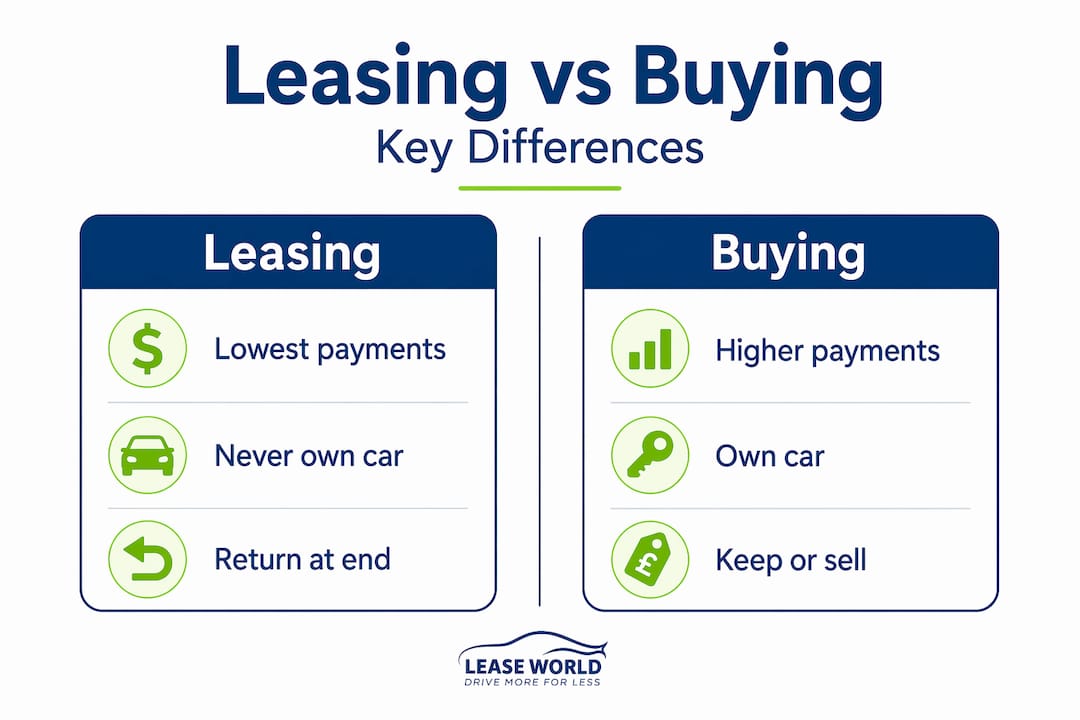
This is where most people get confused, so it is worth being precise. Here is a direct comparison of the three main options:
| Feature | Leasing (PCH) | PCP | Outright buying |
|---|---|---|---|
| Monthly payments | Generally lowest | Mid-range | Highest (loan) or none |
| Ownership at end | No | Optional (balloon payment) | Yes |
| Equity built up | None | Potentially | Yes |
| Flexibility to change car | Every 2 to 4 years | Every 2 to 4 years | Whenever you sell |
| Mileage restrictions | Yes | Yes | No |
| End-of-term options | Return only | Return, part-exchange, or buy | N/A |
The key difference between leasing and PCP is what happens at the end of the contract. With PCP, a balloon payment allows you to keep the car if you choose to. With PCH leasing, there is no such option. You return the car, full stop. This matters if building equity in an asset is part of your financial thinking.

Leasing generally suits people who want predictable, lower monthly costs and enjoy driving a new car every few years without the hassle of selling. Buying outright or via a loan suits those who drive over 12,000 miles per year heavily or who want to own the vehicle as an asset over time.
Pro Tip: If you are considering an electric vehicle, leasing can be particularly attractive. EV technology is evolving rapidly, and a 2 to 3 year lease means you avoid being locked into a battery technology that may be outdated before you are ready to move on.
Mileage limits, wear and tear, and end-of-lease charges
This section covers the costs that catch people off guard. Read it carefully, because a clear understanding here can save you hundreds of pounds.
-
Understand your mileage before you sign. Your annual mileage allowance is agreed at the start of the contract and directly affects your monthly payment. A higher mileage allowance means the residual value is lower, so the payment goes up. Many people underestimate how many miles they drive, particularly those who commute or travel regularly for work.
-
Know the cost of going over. Excess mileage charges can run from 5p to 30p per mile depending on the vehicle. On a premium car, exceeding your limit by 3,000 miles could result in a charge of £900. That wipes out months of saving from choosing to lease over buying.
-
Prepare for the end-of-lease inspection. A vehicle inspection is conducted at lease end to identify any damage beyond normal wear and tear. The inspector uses the British Vehicle Rental and Leasing Association (BVRLA) fair wear and tear guidelines, which are precise and formal. Do not assume inspectors apply common sense. Even minor damages can be chargeable if they fall outside the stated guidelines, regardless of how trivial they seem.
-
Check the BVRLA guidelines yourself. These are freely available and specify acceptable levels of scratches, dents, tyre wear, and interior damage by vehicle age. Reviewing them six months before your contract ends gives you time to carry out small repairs cheaply before the inspector arrives.
-
Consider a maintenance package. Some leases allow you to add a servicing and maintenance package to your monthly payment. This covers routine servicing and sometimes tyres, keeping the car in good condition throughout the agreement and reducing the risk of end-of-lease charges.
Pro Tip: Take dated photographs of the car at the start of the lease and again at regular intervals throughout. If there is ever a dispute about pre-existing damage, clear photographic evidence is your best defence.
The leasing process from start to finish
Knowing what to expect at each stage removes a lot of the anxiety around leasing for the first time. Here is how the process typically unfolds:
- Choosing your vehicle and terms. You browse available models, choose a contract length and annual mileage, and get a quote. The full leasing process from enquiry to delivery is more straightforward than most people anticipate.
- Credit check and application. The finance company runs a credit check before approving the agreement. Your credit score influences whether you are accepted and may affect the rate offered.
- Initial rental payment. Once approved, you pay an initial rental (typically 1, 3, or 6 months upfront) before or upon delivery. A higher initial rental lowers your subsequent monthly payments.
- During the lease. You are responsible for insuring the vehicle (fully comprehensive cover is required by the finance company), keeping it serviced in line with the manufacturer's schedule, and staying within your agreed mileage. The car remains the property of the finance company throughout.
- Approaching the end of the contract. Around three months before the lease ends, start thinking about what you want to do next. If you want a new lease, initiate the process early to avoid a gap in cover or being left without a vehicle.
- Returning the car. The collection is arranged through the finance company or a logistics partner. The vehicle is inspected, and assuming it meets the fair wear and tear standard and is within mileage, the contract closes without additional charges.
My honest take on whether leasing is right for you
I have spoken to thousands of people over the years who were weighing up leasing against buying, and the honest answer is that leasing is brilliant for some people and genuinely unsuitable for others. What surprises me is how often people make the decision based on the monthly payment alone without thinking through their actual driving habits.
The people who get the most from leasing are those who want a new, reliable car, drive a predictable and moderate annual mileage, and do not want the hassle of depreciation risk or selling privately. If that is you, the benefits of leasing are real and significant. Lower monthly costs, no ownership headaches, and a fresh car every few years.
Where I see people come unstuck is when they sign a lease for a mileage limit that suits the payment they want rather than the mileage they actually drive. I have seen people rack up thousands of pounds in excess mileage charges that were entirely avoidable. Always set your mileage based on reality, not optimism.
The wear and tear rules also trip people up. Inspectors apply formal policies, not common sense, and those policies are more stringent than most drivers expect. If you are someone who is hard on a vehicle or parks in tight supermarket car parks regularly, budget for a small repair bill at the end or consider an arrangement with more flexibility.
Leasing works beautifully as part of a longer-term vehicle plan if you review your options every few years and treat it as the financial product it is rather than just a way to get a car you might not otherwise afford.
— Jason
Find your next lease deal with Lease World
At Lease World, we make car leasing straightforward from the first enquiry to the moment the car arrives on your driveway. We work with a carefully selected panel of finance providers to find you competitive rates on both personal car leasing and business vehicle leasing across a wide range of makes and models. Whether you are drawn to a compact hatchback, a family SUV, or the latest e car lease options on electric vehicles, our team is on hand to guide you through every step.
Because we are a family-run, independently operated business, every customer gets genuine one-to-one attention. We do not disappear after the quote is sent. Browse our full range of UK car lease deals or get in touch directly and we will do the legwork to find you the right vehicle at the right monthly cost. Our strong customer reviews speak for themselves, and we would love the opportunity to add you to that list.
Common questions
What is the difference between leasing and PCP?
With Personal Contract Hire (leasing), you return the car at the end with no option to buy. With PCP, you can make a final balloon payment to keep the vehicle, which gives you flexibility that leasing does not offer.
Can I lease a car with bad credit?
Leasing requires a credit check, and approval depends on your credit history and the finance provider's criteria. Some providers work with customers who have less-than-perfect credit histories, though rates may be higher.
What happens if I exceed my mileage limit?
Excess mileage charges apply at the per-mile rate stated in your contract, ranging from 5p to 30p per mile. These are calculated at the end of the lease and can add up to a significant sum if you go over by a large margin.
Who is responsible for servicing a leased car?
You are responsible for keeping the vehicle serviced in line with the manufacturer's schedule throughout the lease. Some agreements offer an optional maintenance package that covers routine servicing as part of the monthly payment.
Do I own the car at the end of a lease?
No. With a Personal Contract Hire agreement, ownership never transfers to you. The car belongs to the finance company throughout and is returned at the end of the contract.