

Yes, you usually can change your lease mileage mid-contract, but the funder has to agree to it, and your monthly payment will almost always go up. Most lenders will only consider a request once you're six to twelve months into the agreement, and they'll want to see your current odometer reading before quoting a new price.
Before you pick up the phone, do three things:
- Check your contract for the exact pence-per-mile excess charge.
- Work out how many extra miles you actually need for the rest of the term.
- Ask for a written quote and compare it against what you'd pay in excess charges at handback.
Excess-mileage rates on UK leases typically run between roughly 3p and 30p per mile, so the gap between the cheapest and most expensive contracts is enormous. That's why the sums are worth doing properly rather than guessing.
Key Takeaways
Changing your lease mileage mid-contract usually pushes your monthly payment up immediately, so compare that rise against the excess-mileage charge before agreeing to anything.
| Point | Details |
|---|---|
| Funder approval required | Most funders only consider changes after six to twelve months, and approval is discretionary. |
| Monthly payments rise immediately | Increasing your allowance almost always raises the payment straight away, not just at handback. |
| Excess rates vary widely | UK excess-mileage charges typically run from about 3p to 30p per mile, so always compare the full sums. |
| Get it in writing | Confirm the new mileage total, monthly cost, and any admin fee on paper before you agree. |
| Lease World reviews the numbers for you | Lease World liaises with your funder and gets a written amendment quote so you can compare it against excess charges. |
For further reading, National Debtline offers guidance if unexpected lease charges cause financial strain, and WhatCar's guide to excess-mileage charges breaks down how yearly allowances are calculated.
Table of Contents
- Eligibility and timing: when can you adjust lease mileage?
- How to request a mileage amendment
- Is it cheaper to increase mileage or pay excess charges?
- When should you avoid amending your lease mileage?
- What Lease World sees in practice with mileage changes
- Get a written mileage quote through Lease World
- Sources
- FAQ
Eligibility and timing: when can you adjust lease mileage?
Funders generally won't touch a mileage amendment in the first few months of a contract. Alphabet's own guidance for UK drivers confirms that increases are usually considered only after six to twelve months, largely because the residual value the funder set at the start was calculated against your original mileage. Change that number too early and the whole risk model behind your contract shifts.
Not every funder plays by the same rulebook, either. Some will flatly refuse mid-term increases regardless of how long you've had the car; others will approve them but load on a higher admin fee than you'd expect. It pays to ask directly rather than assume.
The type of agreement matters too:
- On a Personal Contract Hire (PCH) deal, mileage is central. You're handing the car back at the end, so every excess mile costs you directly.
- On a Personal Contract Purchase (PCP) agreement, mileage still affects your Guaranteed Minimum Future Value, but if you plan to buy the car outright at the end, the mileage cap matters far less.
If PCH and PCP still feel like alphabet soup, Lease World's glossary of leasing terms is worth a quick read before you call anyone.
How to request a mileage amendment
Getting a mileage change agreed is mostly a paperwork exercise, provided you approach it in the right order.
- Gather your details first. You'll need your contract or agreement reference, the vehicle's registration or VIN, and a current odometer reading explained.
- Contact the funder or lease administrator. If it's a company car, that's usually your fleet manager rather than the finance company directly, as Lex Autolease's own contract amendment process shows. Ask specifically for a written quote covering the new total contract mileage.
- Scrutinise the quote. Check for an admin fee, and confirm whether the higher monthly payment is backdated to the start of the contract or only applies going forward.
- Get it in writing before you agree to anything. Confirm the new monthly figure and the new total mileage allowance on paper, not over the phone.
Pro Tip: Ask the funder to send the amendment as a formal contract variation, not just an email confirmation. If the deal ever gets disputed at handback, you want a document with both parties' names on it, not a chat log.
You can find more detail on the full process on Lease World's page covering how to change the mileage on a car lease.
Is it cheaper to increase mileage or pay excess charges?
Raising your agreed mileage almost always increases your monthly payment straight away, because the funder is now depreciating the car against a higher total mileage over the same term. PromiseMoney's guidance on lease mileage limits is blunt about this: expect the rise the moment the amendment goes through, and always get the figure in writing with any admin fee included before you sign off.
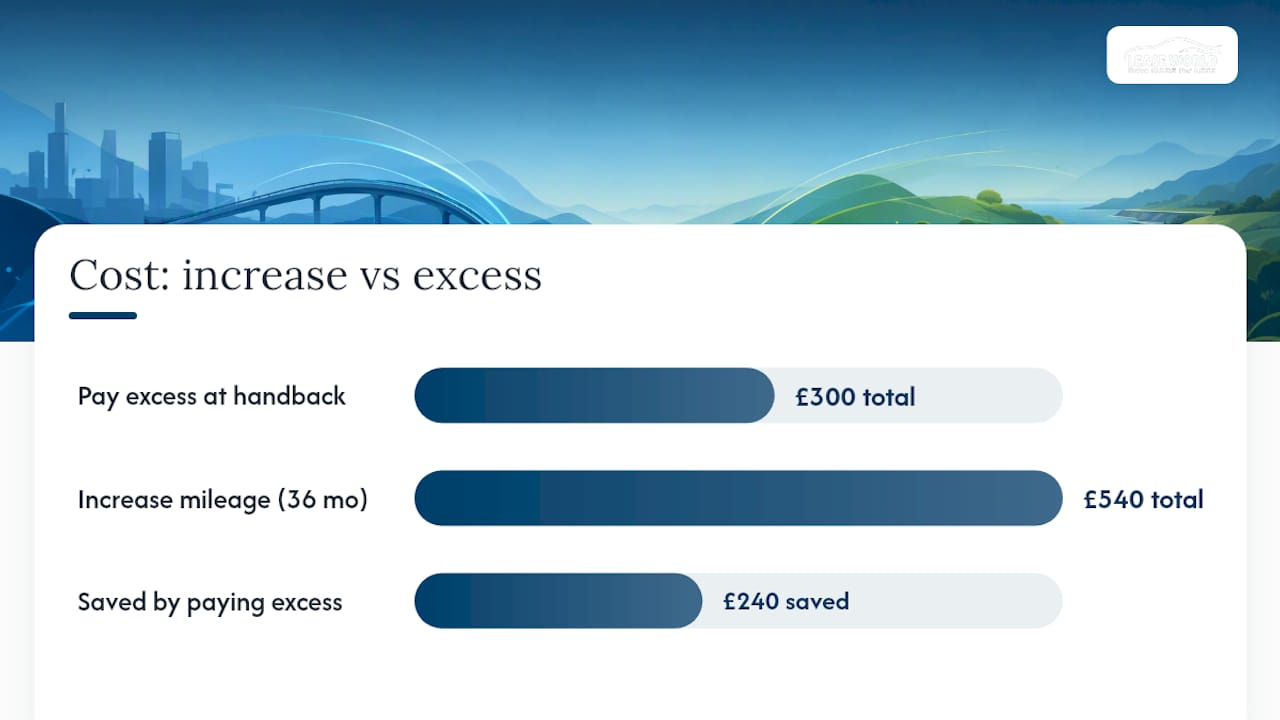
Excess charges at the end of the contract work differently, and the rate varies hugely. Typical UK contracts show excess-mileage charges ranging from roughly 3p to 30p per mile, depending on the vehicle and the funder.
Here's a worked example. Say you're 3,000 miles over your allowance across a three-year term, and your contract charges 10p per mile in excess fees. That's £300 at handback. If a funder instead offers to raise your mileage allowance for an extra £15 a month, that's £540 over three years, more than the excess charge itself. In that scenario, paying the excess fee at the end is the cheaper route.
- Always calculate the total extra monthly cost across the remaining term, not just one payment.
- Include any admin fee in your comparison, since it can tip the balance either way.
- Remember that unused miles from earlier years carry forward across the whole contract, so a quiet first year can offset a busier third year without any amendment at all.
When should you avoid amending your lease mileage?
Increasing your mileage allowance isn't always the smart move, even when a funder offers it.
- If your excess-mileage rate is low, say under 10p a mile, letting the charge sit until handback is often cheaper than paying more every month for the rest of the term.
- If you're on a PCP deal and plan to buy the car at the end, mileage caps matter less; once it's yours, nobody's charging you for extra miles.
- Voluntary termination or early return to dodge a mileage problem is usually the most expensive way out, and should be treated as a last resort rather than a shortcut.
- If a big trip is a one-off, consider whether you can shift it later in the contract, since being under your allowance in earlier years effectively banks miles for later.
If you're weighing this up, it's worth reading what actually happens when you exceed your lease mileage before assuming an amendment is the only option.
Quick checklist before you call your funder
Run through these before you pick up the phone:
- Confirm your exact total contract mileage and the pence-per-mile excess rate written into your agreement.
- Check for a minimum time-in-contract clause that might block an early amendment, and any admin fee attached to changes.
- Read the early or voluntary termination terms and how mileage is treated if you hand the car back before the end date.
- Ask whether a higher monthly payment would be backdated or would only start from the date the amendment is agreed.
What Lease World sees in practice with mileage changes
Customers usually come to Lease World mid-contract, unsure whether a funder will even entertain a mileage change, let alone what it will cost. In our experience helping people through this, funders respond fastest when the request arrives with the right paperwork already attached: registration, current mileage, and a clear number for the new total allowance.
Most funders will quote within a few working days once that's in place. If your own documents feel unclear, Lease World's guide on increasing mileage on a car lease covers the practical detail funders expect.
— Jason
Get a written mileage quote through Lease World
Lease World reviews your contract, contacts the funder on your behalf, and comes back with a written amendment quote, so you're not stuck reading small print or chasing a call centre yourself.
That's the real advantage over sorting it out solo: you get the pence-per-mile figure, any admin fee, and the new monthly payment laid out clearly, and you can weigh it against the excess-charge maths before you commit to anything. Lease World also handles new agreements from scratch if your current deal isn't working for you any more, whether that's personal car leasing, a PCP agreement, or business contract hire. If you'd rather start the conversation with your existing funder today, get a quote through Lease World and we'll take it from there.
Sources
- Excess mileage charges on a lease car explained... and how to avoid them — Autotrader
- Excess mileage charges explained — Carwow
- Are there mileage limits on vehicle lease finance? — PromiseMoney
FAQ
Can you change your mileage on a lease?
Yes, most funders will consider it, usually after six to twelve months into the contract, but it's always subject to their approval and will typically raise your monthly payment.
How much does it cost to increase mileage on a lease?
It depends on the funder, but expect an immediate rise in your monthly payment plus a possible admin fee. Always get a written quote and compare the total extra cost against what you'd pay in excess-mileage charges instead.
Is 10,000 miles a lot for a lease?
It's one of the most common allowances on UK personal leases and suits average commuting patterns, but it's only right for you if it matches your actual annual driving. Check your total contract mileage rather than relying on the yearly figure alone.
Is the mileage rate changing for 2026?
Excess-mileage rates are set individually by each funder and vary by vehicle, not by a single industry-wide rate. Always check your own contract or ask Lease World to confirm the rate attached to your specific agreement.