
Small city cars and superminis rated in the lowest insurance groups by Thatcham Research and the ABI consistently attract the cheapest premiums in the UK. The models that come up most reliably are the Hyundai i10, Kia Picanto, Dacia Sandero, Volkswagen Polo, Skoda Fabia, Fiat 500, Renault Clio, SEAT Arona, Toyota Aygo X, and Volkswagen Caddy. One important change to know: cars registered since August 2024 are assessed under the new Vehicle Risk Rating (1–99) rather than the legacy 1–50 group scale, so the number you see on a listing now depends on when the car was built.
Here is a quick-scan shortlist:
| Model | Why premiums stay low |
|---|---|
| Hyundai i10 | Tiny engine, cheap parts, strong security |
| Kia Picanto | Low power, affordable to repair |
| Toyota Aygo X | Simple mechanicals, low theft risk |
| Fiat 500 | Compact, widely available parts |
| Dacia Sandero | Lowest purchase price keeps repair costs modest |
| Skoda Fabia | Solid security, reasonable repair bills |
| Volkswagen Polo | Good safety scores, widely available parts |
| Renault Clio | Long-running model, parts are plentiful |
| SEAT Arona | Crossover body, but entry trims sit in low groups |
| Volkswagen Caddy | Practical load carrier, low-risk profile for insurers |
Key takeaways
The single most effective step for any UK driver seeking cheap premiums is to choose a car in insurance groups 1–5 (or the equivalent low band on the new 1–99 Vehicle Risk Rating) and pair it with a telematics policy in the first year.
| Point | Details |
|---|---|
| Prioritise group or rating | Cars in groups 1–5 can save new drivers roughly £500–£1,000 a year versus groups 15–20. |
| Always check the exact trim | The same model can span ten or more groups depending on engine and trim; confirm before buying or leasing. |
| Use telematics in year one | A black box policy combined with a low-group car is the most effective combination for new drivers. |
| Personal factors still dominate | Age, postcode, and no-claims history can outweigh the group effect; build NCB as quickly as possible. |
| Lease World checks the spec | Lease World confirms trim and insurance group before you sign, removing the risk of an expensive surprise. |
Table of Contents
- How insurance groups and the Vehicle Risk Rating determine your premium
- The best low insurance cars in the UK: ranked shortlist
- How much can you actually save by choosing a lower-group car?
- How to check a car's insurance group and get an accurate quote
- Practical ways to reduce your insurance cost beyond the car you choose
- Which cars and trims to avoid if low insurance is your priority
- How this shortlist was built
- An honest perspective on what actually matters when choosing a low-insurance car
- Lease World can help you find and lease a low-insurance car
- Sources
- FAQ
How insurance groups and the Vehicle Risk Rating determine your premium
Every car sold in the UK carries an insurance group rating that sets the baseline for any quote you receive. Cars registered before August 2024 sit on the legacy 1–50 scale; anything registered from August 2024 onwards is assessed under the new Vehicle Risk Rating (1–99), which gives insurers a far more granular, multi-axis view of risk. The higher the number, the more expensive the car is to insure.
Thatcham Research and the ABI assign every rating by reviewing more than 125 vehicle attributes. The most influential ones are:
- Repair cost and labour time — how long a standard repair takes and what parts cost
- Parts pricing — assessed against a standard list of components
- Performance — engine power and top speed both push ratings up
- Safety and ADAS systems — modern driver-assistance tech reduces crash frequency but raises repair bills, which can push a car into a higher group than you might expect
- Security — Thatcham's suffix letters matter here: 'E' means security exceeds the minimum requirement (good), 'D' means it falls below (bad), and 'U' can mean some insurers refuse to quote without an upgrade
One nuance worth understanding: modern safety systems reduce accident frequency but increase repair costs, which is why a well-equipped new car can sit in a higher group than a simpler older model. That trade-off is built into the new Vehicle Risk Rating methodology.
A low group or rating does not guarantee the cheapest quote. Driver age, postcode and claims history still materially affect the final price, sometimes by more than the group itself. The group is the baseline; your personal profile is the multiplier.
The best low insurance cars in the UK: ranked shortlist
The ten models below are the ones that appear most consistently on low-group lists from Thatcham, the ABI, and reputable guides. Indicative annual premiums for a young or new driver are included to give a sense of scale; treat them as illustrative ranges only, since your actual quote will depend on age, postcode, and driving history.
All premium ranges are illustrative and based on indicative market data for a new or young driver. Your actual quote will vary.
## 1. Hyundai i10
The i10 is the go-to recommendation for new drivers, and for good reason. Its 1.0-litre engine keeps performance figures low, which directly reduces the group rating. Parts are cheap and widely available, and many trims carry the 'E' security suffix, meaning security exceeds Thatcham's minimum requirement. For a first-year driver, it is hard to find a more forgiving starting point.
## 2. Kia Picanto
The Picanto and the i10 share a platform and compete for the same buyers, so their insurance profiles are almost identical. The Picanto's slightly sportier styling does not translate into a higher group on standard trims. Stick to the 1.0-litre '2' or '3' trim and you stay firmly in groups 1–5.
## 3. Toyota Aygo X
Toyota's city car is mechanically simple by design. The single 1.0-litre three-cylinder engine means there is no tempting higher-power variant to accidentally choose, and the low theft profile keeps security costs modest. It is one of the few genuinely new city cars still on sale in this segment.
## 4. Fiat 500
The 500 sits slightly higher than the Aygo X or i10 on some trims, partly because of its premium positioning and the mild-hybrid system on newer versions. That said, the sheer volume of 500s on UK roads means parts are plentiful and repair times are short, which keeps groups reasonable. Avoid the Abarth 500 entirely if insurance cost is your priority.
## 5. Dacia Sandero
The Sandero's biggest insurance advantage is its purchase price. Because the car costs less to buy, it costs less to write off, and that feeds directly into the repair-cost calculation. The 1.0 TCe engine is frugal and low-powered. For budget-conscious buyers who need more space than a city car offers, the Sandero is the most practical choice on this list.
## 6. Skoda Fabia
The Fabia punches slightly above the pure city cars in terms of size and equipment, but entry-level 1.0 TSI trims remain in groups 3–8. Skoda's parts-sharing with the wider Volkswagen Group keeps component costs sensible. The Monte Carlo trim is the one to avoid; its sportier specification pushes it noticeably higher.
## 7. Volkswagen Polo
The Polo costs more to buy than a Fabia or Sandero, but its safety scores and parts availability keep insurance groups reasonable for a car of its size. The 1.0 TSI 80PS trim is the sweet spot. Move to the GTI and you are looking at groups 20+ immediately.
## 8. Renault Clio
The Clio has been on sale in various forms for over 30 years, which means the parts supply chain is mature and repair times are predictable. The hybrid version is worth considering for running costs, though it sits marginally higher in group than the straight petrol. For an all-rounder that works as a first car or a family runabout, it remains one of the cheapest cars to lease in its segment too.
## 9. SEAT Arona
The Arona is the only crossover on this list, and it earns its place because entry-level 1.0 TSI trims stay in groups 5–12. The higher ride height and SUV styling appeal to buyers who want something more practical than a supermini without paying the insurance penalty of a larger SUV. The FR Sport trim, with its sportier suspension and styling pack, adds groups, so stick to SE or SE Technology.
## 10. Volkswagen Caddy
The Caddy is the outlier here: a small van-derived load carrier rather than a city car. It appears on low-insurance lists because its practical, commercial-vehicle profile means insurers treat it as a workhorse rather than a performance risk. Tradespeople and small business owners often find it one of the most cost-effective vehicles to insure relative to its carrying capacity.
How much can you actually save by choosing a lower-group car?
Moving from insurance groups 15–20 to groups 1–5 can significantly reduce a premium for many new drivers. That is a significant sum, and the gap is widest for the drivers who can least afford it: young and newly qualified motorists.
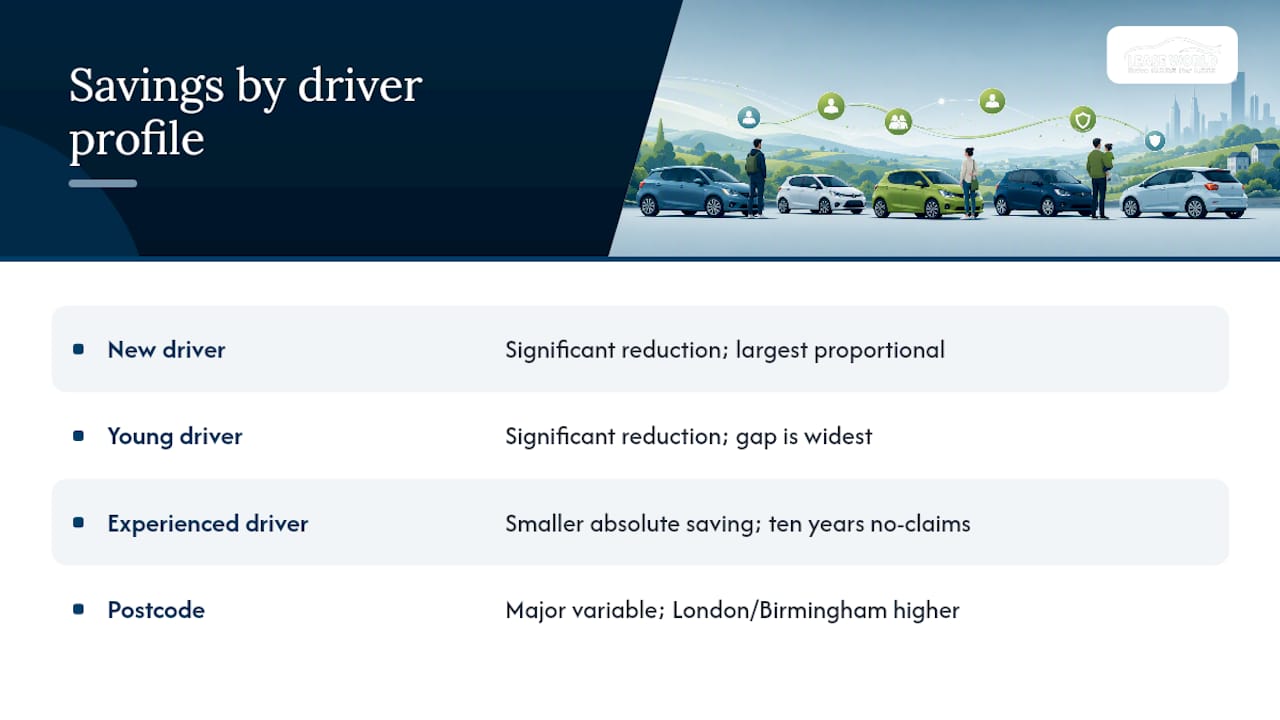
The table below shows illustrative premium ranges by group band for three driver profiles. All figures are indicative and based on market guidance; your actual quote will differ based on postcode, vehicle spec, and insurer.
Figures are illustrative only. Actual premiums depend on postcode, driving history, annual mileage, and insurer.
The savings are proportionally largest for new and young drivers because their base risk profile is already high. An experienced driver with ten years of no-claims discount will see a smaller absolute saving from choosing a lower group, though the principle still holds. Postcode is the other major variable: a driver in central London or parts of Birmingham will pay materially more than the same driver in rural Lincolnshire, regardless of group.
How to check a car's insurance group and get an accurate quote
The quickest route is to use a comparison site's built-in group checker or the Thatcham Research group rating pages before you commit to a specific car. Here is a practical sequence:
- Look up the insurance group or Vehicle Risk Rating using the car's make, model, and year on a comparison site or the Thatcham/ABI lookup. Note whether the car uses the legacy 1–50 scale or the new 1–99 Vehicle Risk Rating.
- Confirm the exact trim and engine — this is where most buyers go wrong. Two versions of the same model can sit three or four groups apart. The 1.0 TSI 80PS Polo and the 1.5 TSI 150PS Polo are very different insurance propositions.
- Run quotes on at least two comparison engines (such as Compare the Market or MoneySuperMarket) using the exact registration or VIN if you have it, rather than a generic model search.
- Call a broker if the quotes look high — brokers sometimes access schemes not available on comparison sites, particularly for young drivers or unusual vehicles.
- Declare everything honestly — modifications, garaging arrangements, and named drivers all affect the quote. Undeclaring a modification to get a lower premium is not worth the risk; a claim can be voided.
One common trap: some trims carry aftermarket security upgrades that change the suffix letter. If a previous owner fitted an approved Thatcham Category 1 immobiliser, declare it — it can move the effective group down. Equally, if a car has had its standard security removed or bypassed, that can push it into a 'D' or 'U' suffix, which some insurers will not cover without remediation.
For leased vehicles, the insurance picture has a few extra wrinkles. Lease agreements typically require fully comprehensive cover, and the funder may specify minimum insurer requirements. The why insurance differs for leased cars guide covers those specifics in detail.
Practical ways to reduce your insurance cost beyond the car you choose
Picking a low-group car is the single biggest controllable lever, but it is not the only one. Telematics policies, named experienced drivers, paying annually, and raising voluntary excess are all commonly effective for young drivers, though each comes with trade-offs.
- Telematics (black box) policy — a small device or app monitors your driving behaviour. For new drivers, this can cut first-year premiums substantially. The trade-off is that late-night driving or hard braking events can push the score down and increase renewal costs.
- Named experienced driver — adding a parent or experienced driver to the policy can reduce the premium. Never list them as the main driver when they are not; that is fronting and is illegal.
- Pay annually — monthly payment plans typically include an interest charge. Paying in one lump sum removes that cost.
- Increase voluntary excess — agreeing to pay more in the event of a claim reduces the insurer's risk, which lowers the premium. Only do this if you can genuinely afford the excess amount.
- Limit annual mileage — if you drive fewer than 6,000–8,000 miles a year, declare it accurately. Lower mileage reduces statistical risk.
- Advanced driving courses — the Pass Plus scheme and IAM RoadSmart qualifications are accepted by some insurers for a discount. Not all insurers recognise them, so check before booking.
- Garage the car overnight — a locked garage reduces theft risk and can lower the premium compared with parking on the street.
Pro Tip: Check whether the trim you are buying carries the Thatcham 'E' security suffix before you sign. A car with standard-fit Category 1 immobilisation and an alarm that meets Thatcham's requirements gets the 'E' suffix, which signals to insurers that security is above the minimum. On some models, the difference between a trim with 'E' and one without is a full group — and that can translate directly into a lower quote without any additional outlay.
One pitfall to avoid: splitting your no-claims discount across two policies. Some drivers try to use their NCB on a second car simultaneously, which most insurers do not permit. Check the terms carefully.
Which cars and trims to avoid if low insurance is your priority
Performance trims, rare models, and cars with expensive repair profiles push premiums up sharply. The rule is simple: the more it costs to repair or replace, the more it costs to insure.
- High-power engine variants — the GTI, ST, RS, and similar performance trims of otherwise sensible models jump several groups immediately. A Volkswagen Polo GTI sits in groups 20+; the standard 1.0 TSI sits in groups 4–8.
- Sporty trim packs on city cars — Abarth versions of the Fiat 500, the Hyundai i20 N Line, and similar sporty derivatives of normally low-group cars can double the insurance cost.
- Low-sales specialist models — cars with limited UK sales volumes have expensive, hard-to-source parts. Repair times are longer, and that feeds directly into the group rating.
- Cars with dense ADAS sensor arrays — modern safety systems reduce accident frequency but increase repair severity. A windscreen with a camera and radar sensor embedded in it costs significantly more to replace than a plain piece of glass, and those repair costs affect group ratings in ways that are not always obvious from the spec sheet.
- Models with 'D' or 'U' security suffixes — a 'D' suffix means security falls below Thatcham's minimum requirement; 'U' can mean some insurers refuse to quote at all. Check the suffix before buying.
A note on electric vehicles: Many EVs sit one to three groups higher than their petrol equivalents, despite lower running costs. Battery replacement costs, specialist repair requirements, and the expense of recalibrating sensors after even minor bodywork all contribute. If you are considering an EV primarily for low insurance, compare the group carefully against a petrol alternative. The electric car leasing versus petrol cost comparison covers this trade-off in more detail.
How this shortlist was built
This shortlist combines Thatcham Research and ABI group data, insurer pricing guidance, comparison-site checks, and Lease World's own market insight from arranging leases across a wide range of models and trims.
The specific checks performed for each model were:
- Group or Vehicle Risk Rating lookup for the most common trim and engine combinations
- Trim-level confirmation to identify which variants stay in low groups and which jump
- Cross-referencing against reputable published guides including WhatCar, the RAC, and CarInsuranceExpert
- Indicative premium ranges drawn from comparison-site market data for a new or young driver profile
Sources used: Thatcham Research (group rating and suffix data), ABI (Vehicle Risk Rating methodology), WhatCar, Aviva, MoneyHelper, CarInsuranceExpert, and the RAC.
Limitations to note: Insurance groups vary by trim and engine, not just model name. Regional quote variance can be significant. Premium ranges in this article are illustrative; always get a personalised quote using the exact VIN or registration. The market is also moving quickly: the transition to the Vehicle Risk Rating (1–99) means that newer cars may carry a rating that does not map directly onto the legacy group scale you see quoted elsewhere.
An honest perspective on what actually matters when choosing a low-insurance car
Most articles on this topic present the insurance group as if it were the whole story. It is not. The group is the starting point, and for a new driver it is the most important single factor you can control before you buy. But the gap between a group 1 car and a group 5 car is often smaller than the gap between a group 5 car with telematics and a group 5 car without it.
The more interesting question is what happens after year one. A new driver who picks a group 1 car, drives carefully on a telematics policy, and builds two or three years of no-claims discount will often find that their renewal quote on a group 8 or 10 car is lower than a peer's quote on a group 2 car with a poor driving record. The group matters most at the start, when your personal risk profile is an unknown quantity to the insurer.
There is also a practical trap that catches a lot of buyers: they research the model and forget to check the trim. The Volkswagen Polo is a sensible, low-group car. The Polo GTI is not. The Skoda Fabia is a sensible choice. The Fabia Monte Carlo is a different conversation. Manufacturers use the same nameplate across a wide range of specifications, and the insurance group can vary by ten or more groups within a single model range. Always check the exact trim before you commit.
One more thing: the new Vehicle Risk Rating (1–99) is not just a renumbered version of the old system. It gives insurers a richer, multi-dimensional view of risk, which means that checking a car's rating is becoming more important, not less. The days of a single number telling you everything you need to know are ending.
Lease World can help you find and lease a low-insurance car
Choosing the right trim to keep insurance costs down is exactly where a good lease broker earns its keep. Lease World is a family-run vehicle leasing broker that helps private drivers and businesses find the right car at the right spec, with fixed monthly payments, no-deposit options on eligible vehicles, and free mainland UK delivery.
When you lease through Lease World, the team can confirm which trim and engine combination keeps a model in its lowest available insurance group before you sign, so you avoid the common mistake of leasing a variant that sits three groups higher than the one you researched. That spec-checking is part of the service, not an add-on. For drivers who want the lowest possible running costs from day one, personal car leasing through Lease World is a practical route to a known-spec, low-insurance vehicle with no surprises on the contract. Ready to find the right car? Get a tailored quote and the team will confirm the exact trim and insurance group before you commit.
Sources
- Car insurance groups explained: the 1–50 guide (UK 2026) | CarInsuranceExpert
- New vehicle risk rating model launching to help insurers keep pace with new and emerging vehicle risks | Thatcham Research
- Car insurance groups and new vehicle risk ratings explained | WhatCar?
- A guide to car insurance groups | Aviva
- Car insurance for young drivers – the key facts | MoneyHelper
Always confirm the trim and engine before running a quote. A generic model search can return a group that does not match the specific car you are buying or leasing.
This article is general information, not a substitute for advice from a qualified financial advisor. Consult a qualified financial professional about your own circumstances before acting on anything here.
FAQ
What cars are in insurance groups 1, 2, 3, and 4?
The most common group 1–4 cars in the UK include the Hyundai i10, Kia Picanto, Toyota Aygo X, and Dacia Sandero on entry-level trims. These are small, low-powered petrol models with cheap parts and strong security ratings.
Which car is the least expensive to insure in the UK?
The Hyundai i10 and Kia Picanto consistently appear at the very bottom of the insurance group scale, making them the most reliably cheap cars to insure for new and young drivers in the UK.
Which cars will be the cheapest to insure in 2026?
The same small city cars and superminis that dominated low-group lists in previous years remain the cheapest in 2026: the Hyundai i10, Kia Picanto, Toyota Aygo X, and Dacia Sandero. Cars registered from August 2024 now use the new Vehicle Risk Rating (1–99) rather than the legacy 1–50 scale, so check which system applies to the car you are considering.
What is the new Vehicle Risk Rating and how does it differ from the old system?
The Vehicle Risk Rating (1–99) replaced the legacy 1–50 insurance group scale for cars registered from August 2024. Developed by Thatcham Research and the ABI, it gives insurers a more granular, multi-axis view of risk based on over 125 vehicle attributes, making exact trim and spec checks more important than ever.
Does a low insurance group guarantee the cheapest premium?
No. A low group sets a favourable baseline, but driver age, postcode, and claims history can outweigh it. A new driver in a high-risk postcode will still pay significantly more than an experienced driver in the same car, even in group 1.