
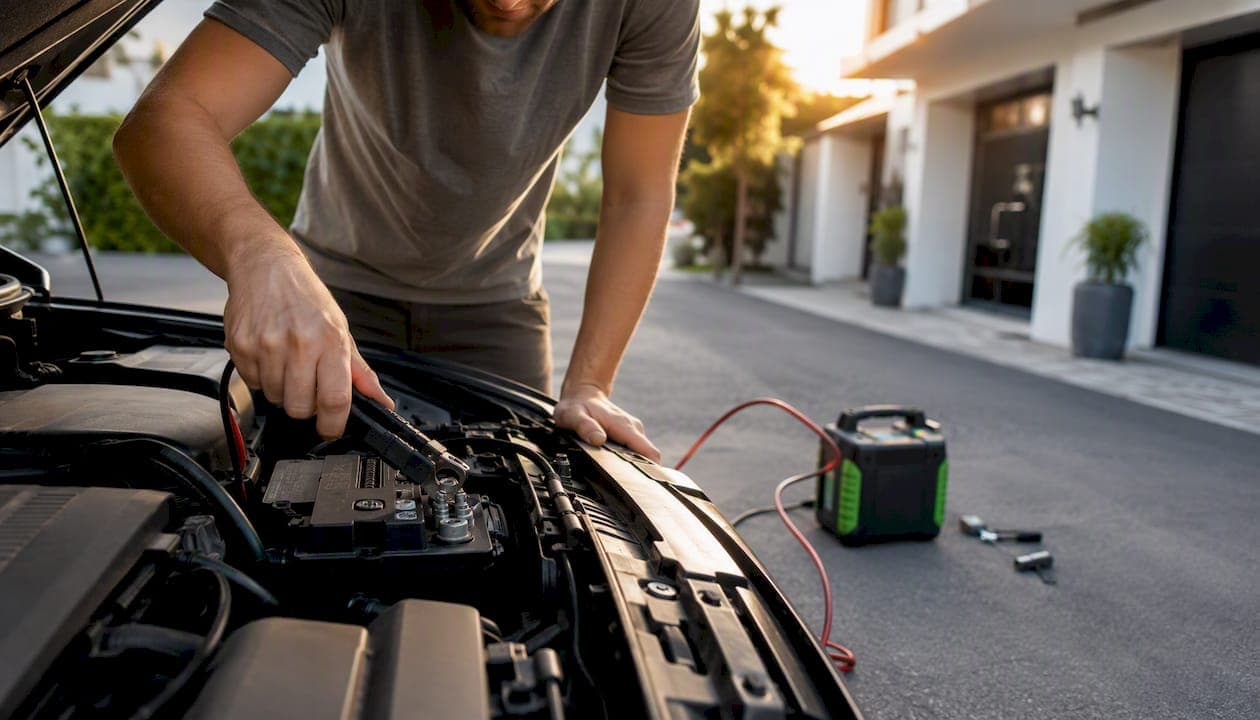
If your car won't start, the most likely culprit is a flat battery. Run through four quick checks first: do the dashboard lights come on, does the central locking respond, do you hear a clicking sound when you turn the key, and is there fuel in the tank? If the lights are dim or dead and you hear rapid clicking, a flat battery is almost certainly the cause. From there, your options are a safe jump-start using cables, a portable booster pack, or a call to a breakdown service if the battery looks damaged.
Before you attempt anything, check the battery visually. If it is cracked, swollen, leaking fluid, or covered in heavy white corrosion, do not attempt a jump-start. Keep clear of sparks near the battery, and if in any doubt, call a professional. A damaged battery can vent hydrogen gas and, in rare cases, ignite.
Here is a quick one-minute check to run before you decide what to do next:
- Turn the ignition key and watch the dashboard. Dim or no lights point to a flat battery.
- Try the central locking with the key fob. No response could mean a dead fob battery rather than a flat car battery — test a spare fob before assuming the worst.
- Listen for a rapid clicking when you turn the key. That sound is the starter motor failing to engage because of low voltage.
- Glance at the fuel gauge. A car won't start without fuel, and the symptoms can feel similar.
- Look at the battery itself. Swelling, cracks, or leaking acid mean stop and call for help.
Once you have confirmed the battery is the issue and it looks physically sound, move to the next step: a jump-start, a booster pack, or a call to your breakdown provider.
Key takeaways
A flat car battery is almost always fixable with the right checks, a safe jump-start or charge, and straightforward prevention habits.
| Point | Details |
|---|---|
| Check before you connect | Confirm the battery is not cracked, swollen, or leaking before attempting any jump-start. |
| Follow the cable order | Connect positive first, earth the negative clamp to the engine block, and remove in reverse order. |
| Charge properly after starting | Drive for at least 30 minutes or use a smart charger — idling does not recharge a depleted battery. |
| Test if it keeps going flat | A battery that fails repeatedly needs a load or conductance test, not another jump-start. |
| Prevent with regular driving | A 30-minute drive once a week and a smart maintainer for stored cars are the most effective long-term fixes. |
Table of Contents
- How do you confirm the battery is actually the problem?
- How to jump-start a car safely using cables
- When should you use a portable booster pack instead?
- What to do if a jump-start or booster fails
- How to replace a car battery safely
- How to stop a flat battery from happening again
- What experts say about parasitic drains, jump-start limits and safety
- A practical note from the team at Lease World
- Sources
- FAQ
How do you confirm the battery is actually the problem?
A flat battery is the most common reason a car won't start, but it is not the only one. Ruling out other faults before you start connecting cables saves time and avoids unnecessary risk.
Quick functional checks
- Dashboard warning lights dim or fail to illuminate when you turn the ignition on.
- Interior lights are noticeably weaker than usual or do not come on at all.
- Central locking is unresponsive or sluggish.
- The starter motor makes a rapid clicking sound but the engine does not turn over.
- The engine turns over very slowly, as though it is struggling to fire.
If central locking fails, test a spare key fob before assuming a flat car battery. A dead fob battery is a surprisingly common cause of what looks like a vehicle electrical fault, and swapping the fob takes ten seconds.
Voltage thresholds: what a multimeter tells you
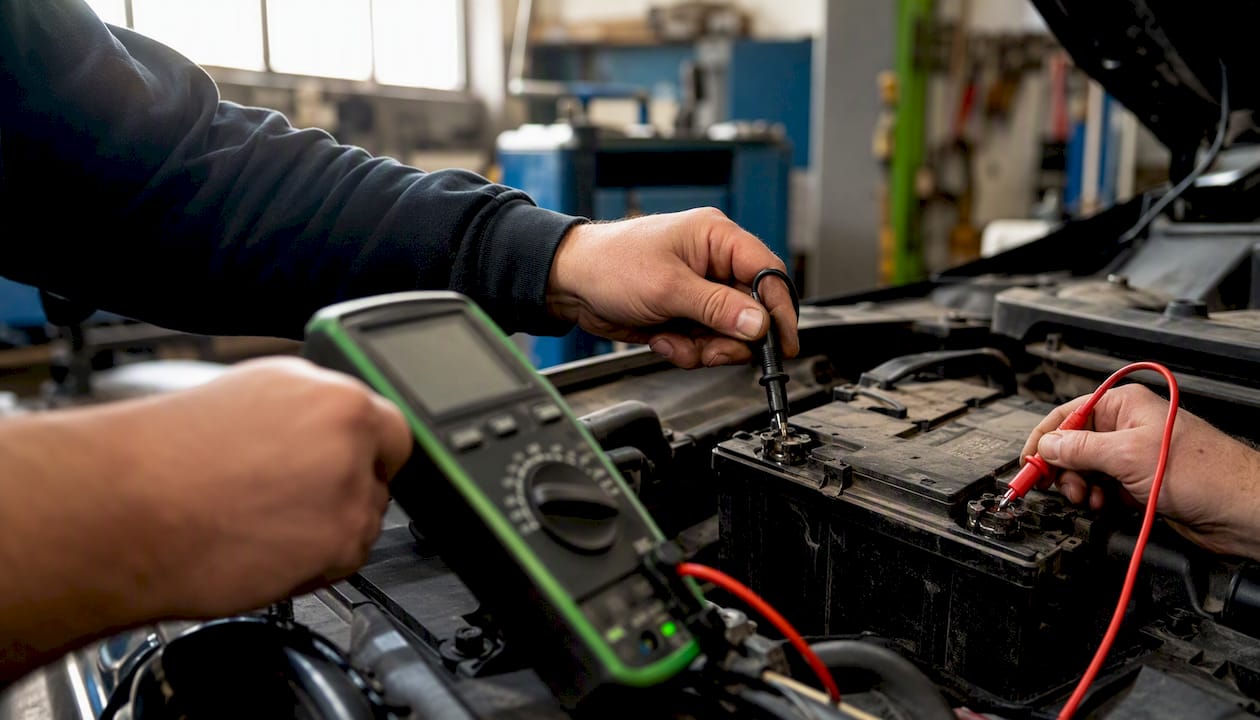
A basic multimeter costs around £10–£15 and gives you a clear picture of battery health. Measure across the terminals with the engine off (open-circuit voltage):
Parkers notes that a healthy, fully charged battery should read around 12.6V at rest.
Visual inspection: when to stop and call a professional
Before touching the battery, look for any of the following:
- Cracked or bulging casing
- Visible acid leakage (white or blue-grey residue around terminals)
- A frozen or frosted battery in winter
- Heavy corrosion that has spread beyond the terminals
Any of these mean no jump-starting. Call a breakdown service or mobile battery replacement instead. The AA's guidance distinguishes clearly between a flat battery (discharged but otherwise intact) and a dead battery (failed internally or physically damaged), and the correct response to each is different.
How to jump-start a car safely using cables
Jump-starting is a reliable flat battery solution when the battery is physically sound and you have a suitable donor vehicle. The connection order matters: get it wrong and you risk a spark near the battery or, worse, a voltage surge that damages the car's electronics.
What you need first: jumper cables rated for your engine size (thicker gauge for diesel or larger petrol engines), a donor vehicle with a healthy battery of similar or greater voltage, and both cars parked so the batteries are close but the vehicles are not touching.
- Switch off both vehicles. Apply the handbrake on each.
- Connect the red (positive) clamp to the positive terminal (+) on the flat battery.
- Connect the other red clamp to the positive terminal (+) on the donor battery.
- Connect the black (negative) clamp to the negative terminal (–) on the donor battery.
- Connect the final black clamp to an unpainted metal earth point on the engine block or chassis of the flat car, away from the battery. This reduces the risk of a spark near the battery venting area.
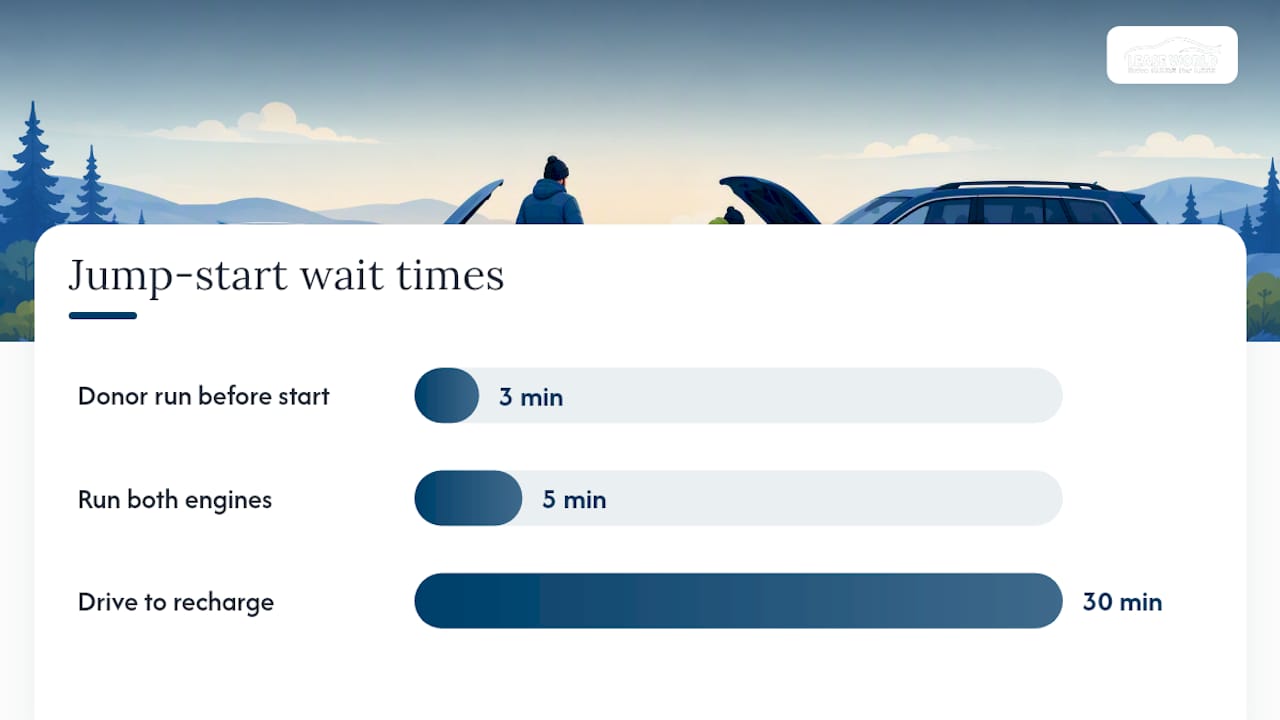
- Start the donor vehicle and let it run for three minutes before attempting to start the flat car. The Telegraph's jump-start guide recommends this wait to allow some charge to transfer and to reduce the load on the donor's alternator.
- Attempt to start the flat car. If it starts, let both engines run for a further five minutes.
- Remove the cables in reverse order: black earth clamp first, black donor clamp, red donor clamp, red flat-battery clamp.
- Drive the recovered car for at least 30 minutes to allow the alternator to begin recharging the battery.
Safety points to keep in mind:
- Never use a hybrid or electric vehicle as a donor unless the manufacturer explicitly permits it. Their 12V systems are not designed for this purpose.
- Wear safety glasses and gloves. Battery acid is corrosive and hydrogen gas can accumulate near the vents.
- Keep the cables taut and away from moving engine parts while both vehicles are running.
- If the leads become hot during the process, stop immediately.
Pro Tip: Buy jump leads with a minimum cable length of 3.5 metres and a gauge of at least 16mm². Thin, short cables from budget packs struggle with larger engines and can overheat.
The RAC's flat battery guide recommends professional testing if the battery goes flat again shortly after a jump-start, as repeated failure points to a charging system fault rather than a one-off discharge.
When should you use a portable booster pack instead?
A portable jump starter is the better option when there is no donor vehicle available, when the donor is a hybrid or EV, or when you are parked somewhere that makes positioning two cars side by side impractical. Confirm the pack is fully charged before you need it — a booster sitting in the boot for six months without a top-up may not have enough reserve to start a cold engine.
What to look for when choosing a booster pack:
- Peak amps: check your vehicle handbook for the minimum cold cranking amps (CCA) your engine requires. The booster's peak amp rating should comfortably exceed it.
- Battery chemistry support: if your car has an EFB or AGM battery (common in stop-start vehicles), choose a booster that is compatible with those chemistries.
- Built-in protections: reverse polarity protection and spark suppression are not optional extras. They prevent damage if you connect a clamp the wrong way round.
Connection and start sequence:
- Switch the booster pack off before connecting.
- Connect the red clamp to the positive terminal (+) of the flat battery.
- Connect the black clamp to an unpainted metal earth point on the engine block, not the negative terminal itself.
- Switch the booster on.
- Wait 30 seconds, then attempt to start the engine.
- Once the engine is running, switch the booster off before removing the clamps.
- Remove clamps in reverse order: black first, then red.
When a booster pack will not help:
- The battery casing is cracked, swollen, or leaking.
- The battery is severely sulphated (voltage reads below 10V and will not rise with a charge).
- The booster starts the car but it dies again within minutes, suggesting an alternator fault.
In any of these situations, call a breakdown service. Attempting repeated starts with a booster on a failed battery risks damaging the starter motor and the booster itself.
What to do if a jump-start or booster fails
If the car starts but dies again within a short drive, or if it refuses to start at all despite a good connection, the battery may be beyond a simple jump. Toyota UK advises that a jump-start provides temporary power only; an old battery or one with a failed cell will not hold charge, and professional testing is the correct next step.
Charging the battery properly
Idling the engine in the driveway is not a substitute for a proper charge. At idle, the alternator barely keeps pace with the car's own electrical demand and puts very little back into a depleted battery. Use a dedicated charger instead.
- Slow/trickle charger: typically delivers 2–4 amps. Safe for overnight charging but takes 12–24 hours for a fully discharged battery.
- Smart charger: adjusts the charge rate automatically, cuts off when full, and can recondition mildly sulphated batteries. The better long-term investment for most drivers.
- Fast charger: delivers 10–50 amps and charges in a few hours, but repeated fast charging can shorten battery life.
Testing methods and replacement thresholds
Most tyre and battery retailers will carry out a free or low-cost load test. If the battery fails a load test after a full charge, replacement is the only reliable fix.
Typical costs
Replacement batteries for common UK cars range from around £60 to £180 fitted, depending on battery type and vehicle. Mobile battery replacement services typically charge a call-out fee on top of the battery price. A quality smart charger costs £25–£60 and is worth keeping in the garage for long-term maintenance.
How to replace a car battery safely
Replace the battery when it has visible damage, fails a load test, or is older than its expected service life. Parkers gives a typical lifespan of around 3–5 years for a standard lead-acid battery, though this varies with usage patterns and climate.
Choosing the right replacement
- Group size and dimensions: the new battery must physically fit the tray and have terminals in the same position. Check the handbook or the label on the existing battery.
- Cold cranking amps (CCA): match or exceed the original specification, particularly for diesel engines.
- Battery chemistry: if the car has a stop-start system, it almost certainly requires an EFB or AGM battery. Fitting a standard lead-acid battery in a stop-start car will shorten its life significantly. AGM batteries also offer better cold-weather performance, as detailed in Banshee Battery's AGM cold weather guide.
- Battery registration: some modern vehicles (BMW, VAG group, Mercedes-Benz) require the new battery to be registered to the car's engine management system using diagnostic software. Without registration, the charging profile remains set for the old battery. Check whether your vehicle requires this before fitting.
Safe fitment procedure
- Switch the ignition off and remove the key.
- Disconnect the negative (black) terminal first, then the positive.
- Remove any battery clamp or bracket securing the battery in the tray.
- Lift the old battery out carefully — a standard 12V lead-acid battery weighs 12–20kg.
- Clean the tray and terminal connectors with a wire brush if there is corrosion.
- Place the new battery in the tray and secure the bracket.
- Connect the positive (red) terminal first, then the negative.
- Tighten both terminals firmly but do not overtighten — cracked terminal posts are a common DIY mistake.
After fitting:
- Reset the clock, radio presets, and any electric window or sunroof calibration that the car requires.
- If battery registration is needed, take the car to a dealer or independent garage with the appropriate diagnostic tool.
Disposal: never put an old car battery in household waste. Most garages, tyre fitters, and battery retailers will take it for recycling free of charge. Lead-acid batteries are classified as hazardous waste.
Pro Tip: Take a photo of the old battery label before removing it. The group size, CCA rating, and chemistry type are all printed there, and it saves a trip back to the shop if you forget the spec.
How to stop a flat battery from happening again
The single most effective prevention is regular driving. Short trips of five minutes or less do not give the alternator enough time to replace the charge the starter motor used, so the battery slowly depletes over weeks. Parkers recommends a drive of around 30 minutes once a week for cars that are not used daily.
Common causes to address
- Parasitic drains: dashcams, phone chargers, and aftermarket accessories left plugged in draw current even when the ignition is off. Halfords warns that these drains can silently deplete a battery, particularly in cold weather when capacity is already reduced. Unplug accessories when the car is parked overnight.
- Frequent short trips: the alternator cannot fully recharge the battery on a two-mile school run. Over time, partial cycling degrades the battery faster.
- Cold weather: low temperatures reduce a battery's effective capacity and increase the current needed to start the engine. A battery that manages fine in summer may fail on a cold January morning.
- Alternator faults: if the alternator is not charging properly, the battery will drain even on long drives. A garage can test output voltage in minutes.
- Terminal corrosion: a thin layer of corrosion on the terminals increases resistance and reduces the current available to the starter. Clean terminals annually with a wire brush and apply a light coat of petroleum jelly.
Maintenance schedule
- Weekly: check that no accessories are left plugged in.
- Monthly: glance at the battery terminals for corrosion build-up.
- Annually (from year 3 onwards): ask for a battery load test during a service.
- Long storage: use a smart maintainer. These cut off when the battery is full and prevent overcharging. For off-season storage guidance, Banshee Battery's off-season drain prevention guide covers maintainer selection and disconnection procedures in detail.
Pro Tip: If you lease your vehicle, check whether a full maintenance package covers battery testing and replacement. Some packages include annual health checks that catch a failing battery before it leaves you stranded. Keep a note of any battery warnings or repeated flat incidents for your end-of-lease inspection.
What experts say about parasitic drains, jump-start limits and safety
Repeated flat batteries are not a bad luck problem. They are almost always a symptom of something fixable, whether that is a parasitic drain, a failing alternator, or a battery that has simply reached the end of its life.
Halfords highlights that devices such as dashcams and phone chargers are among the most common sources of parasitic drain, and that cold weather compounds the problem by reducing the battery's effective capacity. A battery that is already marginal in October may fail completely by December.
Breakdown specialists are clear on one point: never attempt to jump-start a battery that is cracked, leaking, or frozen. A damaged battery can vent hydrogen gas and, under the right conditions, ignite. The risk is not theoretical — it is the reason every reputable guide, from the RAC to Which?, leads with this warning before any connection instructions.
Toyota UK's battery guidance makes a point that many drivers miss: a jump-start gets the engine running but does not fix anything. If the battery has a failed cell or the alternator is undercharging, the car will go flat again. Repeated jump-starts without a proper conductance or load test are a cycle, not a solution.
The AA's breakdown advice covers what a patrol will actually do: jump-start where safe, test the battery and charging system on the spot, and recommend replacement if the battery fails. That sequence is worth replicating yourself before calling for help, because it tells you whether you need a new battery or a new alternator.
A practical note from the team at Lease World
Roadside battery problems are one of the most avoidable breakdowns in motoring, yet they remain among the most common. The pattern is almost always the same: a battery that has been quietly degrading for months finally gives up on a cold morning, usually when the driver is already running late.
At Lease World, we see this come up regularly in questions from drivers on personal and business leases. The practical answer is straightforward: know your battery's age, run a voltage check once a year from year three onwards, and keep a smart maintainer if the car sits unused for weeks at a time. Our leasing guides cover maintenance responsibilities for leased vehicles in detail, including what is typically covered under a maintenance package and what falls to the driver. If you have questions about what your lease agreement covers, or you are considering a new lease with a maintenance package included, get in touch with the Lease World team for a no-obligation conversation.

Sources
- What to do if you have a flat or dead battery | RAC Drive
- What to do if your car has a flat battery | The AA
- How to maintain your car battery: tips from our experts | Parkers
- Car battery tips for winter | Halfords blog
- 12V battery care | Toyota (UK) magazine
FAQ
Can you drive a car with a flat battery?
No. A flat battery does not have enough charge to start the engine, so the car will not move under its own power. Once jump-started, you can drive it, but the battery needs a proper charge or replacement before the next cold start.
What should you do if your car battery is flat?
Run the four quick checks (dashboard lights, central locking, clicking sound, fuel level), visually inspect the battery for damage, then either attempt a safe jump-start using cables, use a portable booster pack, or call a breakdown service if the battery is visibly damaged.
What happens if a car battery goes completely flat?
A deeply discharged battery may sulphate, meaning lead sulphate crystals form on the plates and reduce its ability to hold charge. A smart charger can recover mildly sulphated batteries, but a severely discharged or sulphated battery will likely need replacing.
How long should you run a car after jump-starting a flat battery?
Drive for at least 30 minutes at a steady speed to allow the alternator to begin recharging the battery. A short idle in the driveway is not sufficient, as the alternator barely keeps pace with the car's own electrical demand at low revs.
When should a car battery be replaced?
Replace the battery if it is older than 3–5 years, fails a load or conductance test, shows visible damage, or repeatedly goes flat despite being fully charged. A battery that cannot hold charge after a proper charge cycle has failed internally and will not improve.